By APR editor February 20, 2026
Asia Pacific Report
A West Papuan leader has accused the Indonesian government of lying over its operations and “masking” the military role of some civilian aircraft.
Disputing an Indonesian government statement about reported that TPNPB fired upon an aircraft in Boven Digoel, killing both the pilot and copilot, United Liberation Movement for West Papua (ULMWP) interim president Benny Wenda said the aircraft was “not civilian”.
Wenda added that the Indonesian government was “tricking the world” about its military operations in West Papua.
- READ MORE: Confusion over West Papua bombing, displacement claims
- Indonesia bombing refugee camps in West Papua, says Wenda
- More West Papua reports
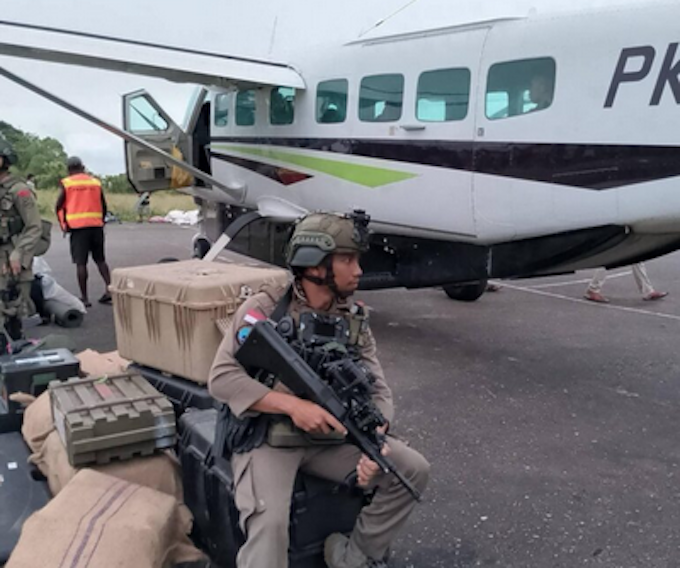
“The Cessna plane the TPNPB [West Papua National Liberation Army] fired upon in Boven Digoel was not a civilian plane, as the police spokesman misleadingly stated, but part of a security operation,” Wenda said in a statement.
“Indonesia is again disguising their military activity as [civilian] activity. They are also willfully breaching the no-fly zones established by the TPNPB.”
The occupied conflict areas in which the Indonesian military TNI were “not permitted to fly” had been “clearly marked out by the TPNPB”.
“This is the same pattern Indonesia used in 1977, when Indonesia used a disguised civilian plane to bomb villages across the highlands and massacre thousands, including many members of my own family,” Wenda said.
Clear strategy
He added there was a clear strategy behind this — “Indonesia wants to avoid the attention that would be drawn by a large scale military buildup, so they mask their introduction of weapons and other military equipment and personnel”.
Wenda said they were effectively “using their own people as human shields”.
Indonesian soldiers and equipment next to a civilian aircraft. Image: ULMWP
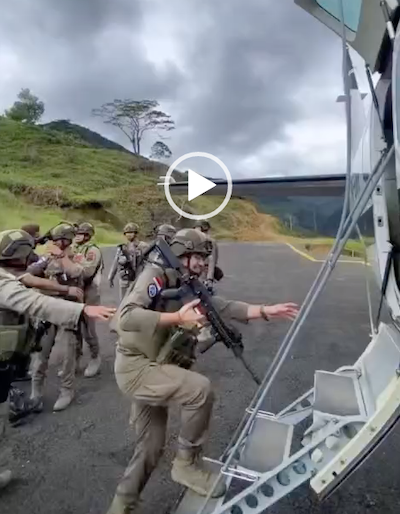
The TPNPB attacks took place on February 11, with the plane being downed and the pilot and co-pilot being killed.
A second attack took place in Mimika, near the Grasberg gold and copper mine, which has been the cause of so much West Papuan deaths over the past 40 years.
“Indonesia then immediately began operating their propaganda machine, claiming that the planes were simply engaged in civilian and medical supply distribution,” Wenda said.
“The truth is that these aircraft were involved in intelligence and security operations.
Media blackout
“Indonesia is only able to spread these lies and mislead the international community because of their six-decades long media blackout in West Papua.
“No journalists or NGOs are allowed to operate in our land. West Papua is a closed society, just like North Korea. I thank God we have civilian journalists to document their lies.”
By breaching these rules the military were inviting further attacks, Wenda said.
“We must always remember that the Indonesian military uses any armed action by West Papuans for their own gain, as a pretext for more militarisation, more displacement, and more deforestation and ecocide.”
Wenda said their aim was always to escalate the situation as a way of ethnically cleansing Papuans, forcing them to become refugees in their own land, and strengthening their colonial hold over West Papua.
“It isn’t a coincidence that in the week since this incident we have seen an escalation in Yahukimo, an Indonesia-occupied community health centre, and transformed it into a military post, displacing and traumatising local residents.”
Using hospitals and other health infrastructure for military means was a clear breach of international humanitarian law, Wenda said.
Normal for military
In West Papua such behaviour was normal for the military.
“In the same week in Puncak regency, Indonesian military personnel seized a school, preventing students from learning and putting ordinary people at risk of harm. Soldiers are posted in classrooms with guns.”
Wenda called on the Indonesian government to withdraw their troops from occupied West Papua, allow civilians to return home, cease using civilian vehicles as a cover for military action, and immediately facilitate a UN Human Rights visit to West Papua — as has been demanded by more than 110 UN Member states.
“Ultimately, Indonesia must come to the table to discuss a referendum,” Wenda said. “This is the only path to a peaceful solution in West Papua.”
An Indonesian Embassy spokesperson blamed the “armed criminal group”, an expression it uses to describe resistance movement fighters.