From infoPAPUA.org
JP by Neles Tebay: New Solution Needed for Papua [+Santa Barbara Intl Film Fest]
By Neles Tebay,
Feb 8, 2008, 15:41
The Jakarta Post
Friday, February 8, 2008
New Solution Needed for Papua
Neles Tebay, Abepura, Papua
The House of Representative issued on Jan. 22, 2008 some 21
drafts of bills around the creation of 21 new regions in
Indonesia, including the formation of four new provinces in
Papua.
The new provinces include South Papua, Central Papua, South West
Papua and West Papua.
In December 2007, the House also issued drafts of bills on the
formation of new regencies, including six new regencies in Papua
province.
While respecting the House's right to take the initiative to
propose new drafts of bills, the question should be: Who is
going to benefit from the creation of new four provinces in
Papua?
Are the four new provinces created for the sake of the
indigenous Papuans?
Is the creation of new provinces to address problems in Papua?
The reality in Papua speaks that some 1.5 to 2 million
indigenous Papuans have not been able to fulfill available jobs
created by newly created regencies.
They lack skillful people due to the poor quality of education
service in Papua and many jobs are vacant in all regencies
across Papua.
In order to run government services, the local government
accepts non-Papuans coming from elsewhere in Indonesia.
Many migrants have been prioritized in job promotions.
So the migrants are now administratively qualified to occupy a
strategic position in government offices in all regencies.
Meanwhile, many Papuans working as public servants in all
government offices are not administratively qualified to occupy
the jobs.
It means all jobs in the government offices will be occupied by
the non-Papuans.
In such a situation, the House decided to create four new
provinces in Papua.
My question, then, is: For whom have the new provinces been
created?
It is not for the Indigenous Papuans.
The non-Papuans coming from other Indonesian provinces will
certainly occupy the jobs.
The creation of new provinces, in turn, will withdraw more
migrants to come to Papua. It will change Papua demographics.
The number of migrants will increase very quickly. Indigenous
Papuans will become the minority in their own land.
So new provinces are created by Jakarta in order to marginalize
native Papuans.
The formation of new provinces has nothing to do with the
problems in Papua.
Papua has a vertical conflict between the Indonesian government
and the indigenous Papuans.
There are also horizontal conflicts between the Papuan tribes
and between the Papuans and the migrants.
Other problems in Papua include poverty, illegal logging,
deforestation, environmental destruction, poor quality of
education and health care services and the spread of HIV/AIDS.
The House should know the lack of provinces is not the root
cause of all these problems.
That's why these problems cannot be settled through the
formation of new provinces.
For example, Papuans' poverty will be settled through
establishing new provinces.
As is happening now in the newly created regencies, the
government will spend a large amount of money to build new
houses and offices, to buy new cars for the officials, and to
pay for official and unofficial trips for government officials
to all the new provinces.
Although Jakarta will form 10 to 20 new provinces in the Western
half of the Island of New Guinea, the problems in Papua will
remain unsettled.
The creation of new provinces is not the proper solution to
Papua's problems -- but serves to address Jakarta's interests.
The Papuans know the problems in Papua have already been
accommodated in Law no. 21/2001 on the special autonomy for
Papua Province.
So the proper way of addressing the problems is not by creating
more provinces but by implementing consistently the autonomy law.
Papuans, then, cannot continue relying much on the
implementation of the autonomy law. Therefore, only one
possibility remains -- to look for new solutions to Papua's
problems.
And the new solution should be jointly discovered in a genuine
dialogue between the government of Indonesia and the
representative of Papuan People, with the help of a third
neutral party as facilitator.
The writer is a lecturer at the Fajar Timur School of Philosophy
and Theology in Abepura, Papua.
----------------------
Santa Barbara International Film Festival
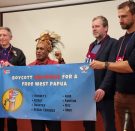
Human Rights for West Papua
Filmmaker Craig Harris and exiled journalist Octovianus Mote
Freeport-McMoRan Corp is destroying the Papuan rain-forest
Richard Elfman, Editor In Chief
Santa Barbara International Film Festival
West Papua: Free to Choose
I just saw a no-budget short film at the SBIFF, a documentary
about the human rights struggle in West Papua (formerly western
New Guinea--now annexed by Indonesia). The story was so damned
compelling that it kicked this writer's butt enough to start
writing Congressmen--as well as writing YOU, my dear Buzzine
readers (and please read this article if nothing else).
When New Guinea (the world's second-largest island--located
north of Australia) gained its independence from the Dutch,
neighboring Indonesia moved right in with a classic "screw the
natives" land grab. The other villain is American-based
mega-mining company, the Freeport-McMoRan Copper & Gold
Corporation, which, in collusion with oppressive military
police, operates a humongous land-stripping and utterly
polluting cash machine, with barely pennies going to the very
people whose land they ruin. It's obscene.
Filmmaker Craig Harris, a carpenter by trade and passionate
human rights activist, keeps the candle burning with this
film-in-progress, as he is attempting to go back to West Papua
and film some more. Helping him and the subject of our following
interview is Octovianus Mote, Papuan human rights activist,
respected journalist in his homeland, and visiting fellow at
Cornell and Yale Universities, who now lives in exile in the
USA--supporting his family with odd jobs at gas stations and
delivering pizza, while trying to finish a book to promote
social justice for his people.
Richard Elfman: Tell us a little about your background.
Octovianus Mote: I am a journalist and activist from (West)
Papua, Indonesia, now residing in the United States. In 1998, I
was appointed by the government of Indonesia as a mediator in
the national dialogue on Papua between representatives of West
Papuan people and the Indonesian government. Following a meeting
with West Papuans and the president of Indonesia in 1999, I was
blacklisted and denied the right to travel outside Indonesia.
Nevertheless, I came to the United States and have held
appointments as a visiting fellow at Cornell and Yale
Universities.
RE: Can you give us a brief history of the situation in West
Papua?
OM: Indonesia maintains control over West Papua, using military
might to deny indigenous people human rights and to quell their
demands for self-determination. Since the invasion in 1963, an
estimated 100,000 Papuans have been killed by Indonesian armed
forces and militias:
Papua is rich in natural resources, including natural gas, oil,
minerals, and rainforests. The Indonesian government relies on
the taxes from foreign sponsored extraction industries which are
devastating the environment and that return few or no benefits
back to the Papuan people. The military is directly involved,
engaging in illegal logging and acting as security teams for
mining companies. Papua is now home to the highest concentration
of illegal logging operations in Asia. Widespread logging and
mining have a serious impact on the livelihood and traditions of
the Papuan people, who rely on the land for survival.
Traditional land is continually being cleared, which has created
conflict amongst the indigenous people, foreign companies, and
Indonesian security forces.
USA-based freeport McMoRan is operating in the world's largest
gold and copper mine in the mountainous home of the Amungme
indigenous people, who have always opposed their presence.
Freeport pays the Indonesian military $5 million per month to
maintain security at the mine. These armed forces and militia
groups regularly use torture, extra-judicial killings, and
forced detention to block Papuans from protecting their
traditional lands and expressing their rights to
self-determination. According to Yale University and University
of Sydney, West Papua is one of ten nations in world that is
facing the possibility of the extinction of its indigenous
people if there is no international intervention.
RE: What happened that caused you to flee West Papua?
OM: My neighbor and close relative, Obeth Badii, was found dead
in a police office. A couple of days earlier, Obeth warned me
about some people looking for me. Military persons had been
following me around--although I was guarded by Papuan people day
and night, I no longer had freedom to work as a journalist.
RE: Is it difficult, living in exile?
OM: On the positive side, for myself and my family, I have
security. My children can go to school without any problems. If
I were in Papua, my family and I would be threatened. Having
political asylum gives me the opportunity to continue in my
human rights work, where I can speak and meet freely. Also,
since I have had political asylum, I have had the privilege of
being affiliated with Cornell and Yale Univeresities, working
with important anthropologists and Indonesian experts. Also, I
have greater access to influential people in the US. For
instance, I meet with US Congressional people, to whom I give
data about Papua.
The negative side of having political asylum is that I feel
distant from people, Where in the past, as a journalist, I had
close connections to my people, now I have to, in part, rely on
other people's reports. Furthermore, there's an issue with
funding. Back home, I had no problems with funding my work,
because I had a consistent job as a journalist. I could give
full attention to my work as a journalist and human rights
advocate. Additionally, I cannot finish my work (on the genocide
project and my book, as well as my lobbying activity) because I
have to work - e.g., in a gas station, delivering pizza, and
transporting medical specimens. This takes up a lot of my time,
but I have to keep my family fed.
RE: What can people--Americans and others--do to help the
situation?
1. Call your representatives (Senate and House) to support this
issue. 2. Lobby the US government to pressure Indonesian
government and military to stop their brutallity in Papua. 3.
Lobby US government to bring this case back to UN as part of
moral responsibility. 4. Make this issue into international
radar through variety of media.
My greatest hope is that the world will recognize West Papua and
support the Papuan people so they can live on their land
peacefully.
---
------------------------------------------
© Copyright by w@tchPAPUA